
[email protected]
0752-6920238
A quiver is an essential piece of equipment for every archer. Beyond storing and protecting arrows, a well chosen quiver improves arrow retrieval rhythm, reduces unnecessary movement, and directly enhances shooting efficiency and overall experience. Different types of quivers suit different bow styles, shooting environments, and personal habits. Choosing the right quiver ensures smoother, safer, and more enjoyable shooting. This guide breaks down the main quiver types, key features, and ideal use scenarios to help you quickly find the style that fits you best.
1. Hip Quiver
Hip quivers refer to all quivers worn around the waist. Based on attachment method and arrow orientation, they include several sub-types and are among the most popular choices for modern archers. Their main advantages are convenience, fast arrow access, lightweight design, and no interference with upper-body movement—making them ideal for target practice and daily training.
1) Belt-Mounted Hip Quiver
These quivers come with an adjustable belt that fits securely around the waist without wobbling. Many models include tool pockets for storing finger tabs, arrow pullers, spare nocks, and other accessories.
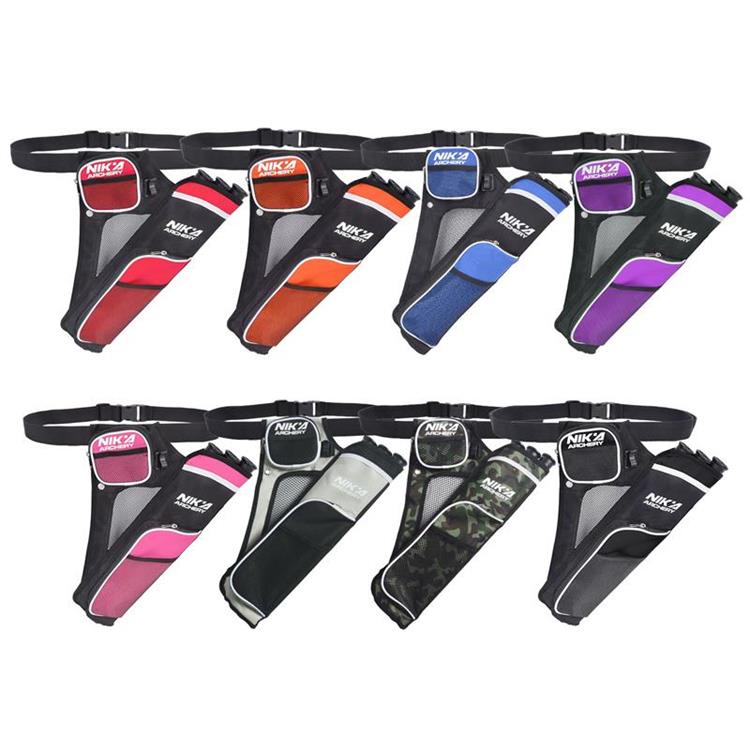
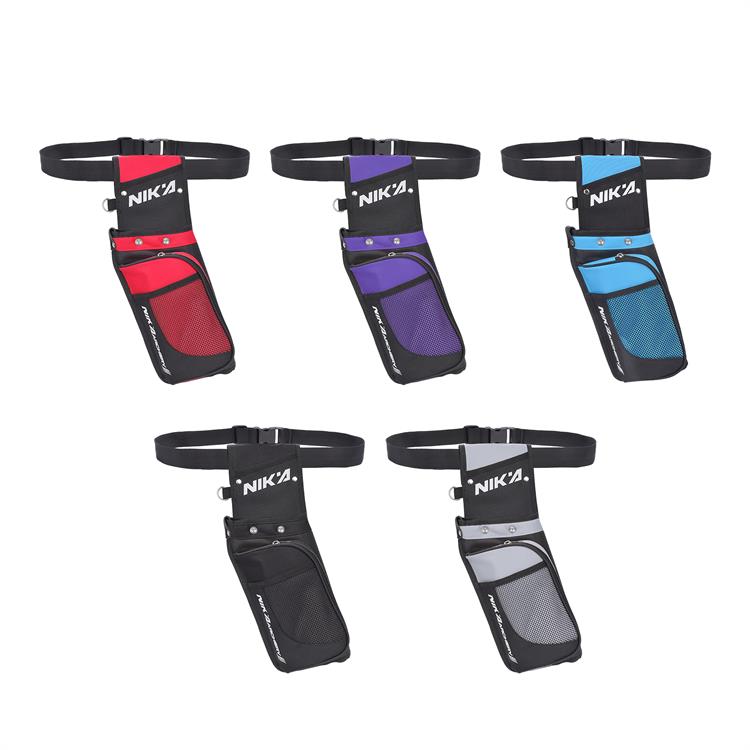
Representative models include the NIKA 3‑Tube Quiver and the NIKA Tournament Quiver.
NIKA 3-Tube Quiver
Arrows are angled forward, and the three‑tube design reduces friction between arrows. With a large capacity (typically 20–30 arrows), archers can retrieve arrows naturally with minimal arm movement. Ideal for long training sessions and archers who prioritize retrieval efficiency. Commonly used in archery clubs and training centers.
NIKA Tournament Quiver
Arrows angle backward instead of forward. This design keeps the front field of vision clear and reduces interference with upper‑body movement. It stays close to the body and minimizes sway while walking, making it especially suitable for outdoor shooting, 3D archery, and scenarios requiring frequent movement.
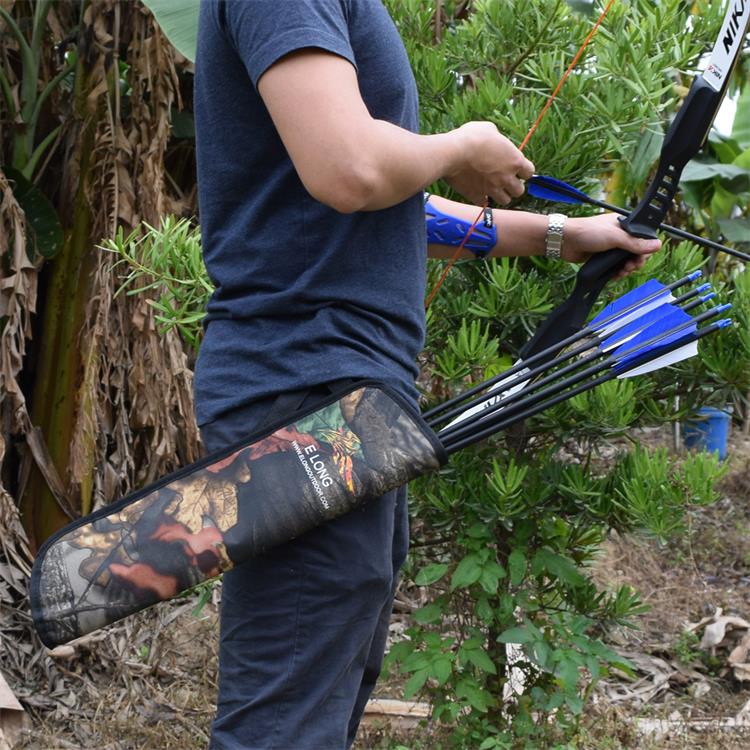
2) Clip-On Hip Quiver
This type attaches directly to a belt loop using a clip—no separate belt needed. Easy to put on and remove, lightweight, and with decent capacity. Ideal for casual training, archers who prefer minimal gear, or as a backup quiver.
Best for: indoor/outdoor target practice, club training, recurve beginners, field archery (non‑hunting), 3D archery, and long training sessions requiring fast arrow retrieval.
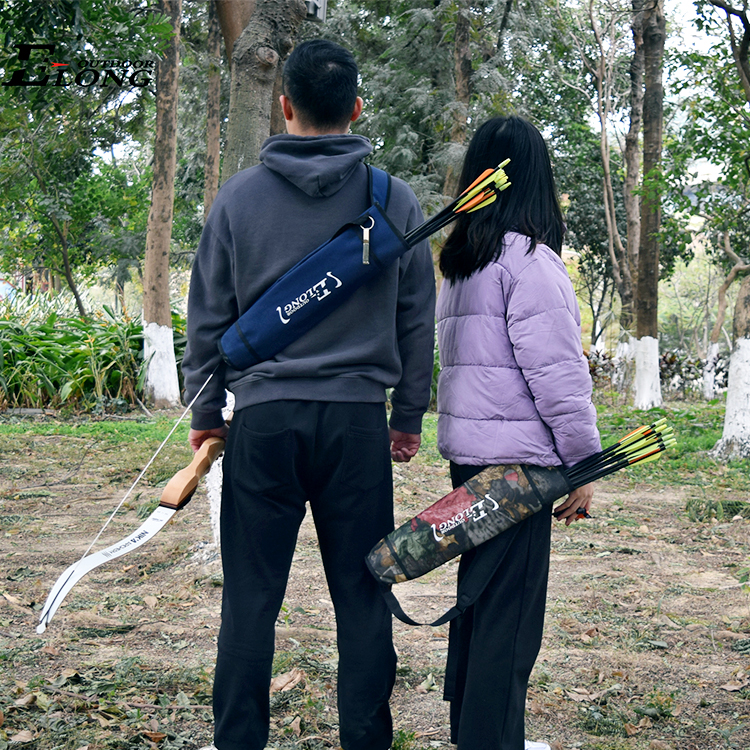
2. Back Quiver
Also known as a shoulder quiver, this style is worn diagonally across the back. Back quivers typically offer large capacity—often 20–30 arrows or more—making them suitable for long outdoor sessions or hunting.
They free the waist area, do not restrict bending or turning, and distribute weight evenly across the shoulders for comfortable long‑term wear.
Modern back quivers are commonly made from waterproof canvas, nylon, or leather. Premium models may use suede or full‑grain leather for durability and a classic aesthetic. Some designs support both hip‑carry and back‑carry modes. Many include side pockets for tools or spare arrows.
Note that back quivers offer slightly slower arrow access compared to hip quivers, making them better suited for scenarios where capacity and comfort matter more than speed—such as traditional archery, outdoor roving, or hunting. Some models use a three‑point harness for added stability during movement.
Best for: outdoor roving, traditional archery, hunting, long outdoor sessions, and archers who need high capacity and comfortable carry.
3. Compound Bow Quiver (Quick-Detach Quiver)
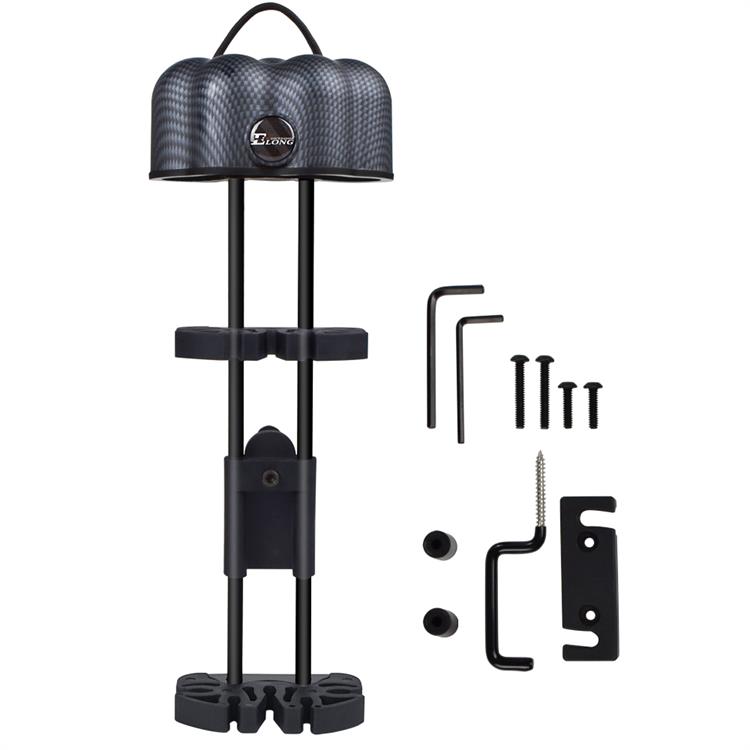
A quick-detach quiver attaches directly to the side of a compound bow. It typically consists of a mounting bracket and a quick-release locking system. Compact and lightweight, this type is designed primarily for compound bow hunting, where silence, stability, and minimal movement are crucial.
Compound bow quivers usually hold 3–6 arrows and feature secure grippers to prevent arrows from falling out. Each arrow slot is separated to avoid contact between broadheads, and many models include protective covers for broadheads to prevent damage.
Lightweight construction ensures the quiver does not add unnecessary weight to the bow. The quick‑detach mechanism allows archers to remove the quiver instantly when needed—useful for tree‑stand shooting or ground blinds.
Best for: compound bow hunting, situations requiring minimal movement, stealth, and consistent shooting performance.
Contact: Kelly yin
Phone: 15918632152
Tel: 0752-6920238
Email: [email protected]
Add: No.4 Lianxing Road,Shiwan Town,Boluo County,Huizhou Guangdong,China 516127
We chat